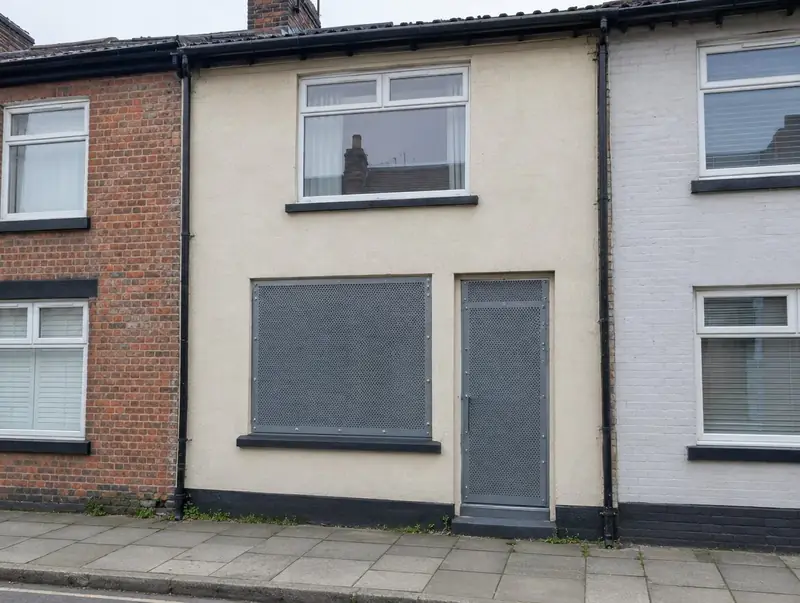
What are vacant property grilles and screens?
Vacant property grilles and screens are steel panels or grilles fixed over the windows and doors of an empty building to stop break-ins, squatting, fly-tipping and vandalism. Perforated steel screens let light and air in while keeping people out, and come down cleanly when the building is reoccupied.
Empty buildings attract attention quickly. Councils, housing associations, landlords and agents use steel screens because they are faster to fit than boarding, stronger, and look less neglected.
We fix perforated steel screens over ground-floor openings and accessible upper windows, and a steel door with a secure lock over the entrance. Screens are recorded, so when the building is ready to reoccupy we remove them and make good the fixing points.
How much do vacant property grilles and screens cost?
Our guide range is £145 to £395 plus VAT (£174 to £474 inc VAT) per opening, supplied and fitted. The exact figure depends on size, type, finish and locking, and your fixed price is confirmed in writing after the free survey. See all grille prices.
Specification and options
- Perforated steel window screens
- Steel security door with a key or code lock
- Anti-tamper fixings
- Light and ventilation through perforations
- Removal and making good at reoccupation
- Schedules for portfolios of empty units
- Fixing to brick, block, timber or uPVC frames
- Supply-and-fit for purchase
Where vacant property grilles and screens are used
- Void council and housing association homes
- Empty shops and offices
- Properties awaiting sale or probate
- Development sites before works
- Buildings between tenants
What to decide before you order
How long it will be empty
For short voids, screens are quick to put up and take down.
Access
Decide who needs access and whether a key or code lock suits them.
Ventilation
Perforated screens help prevent damp in empty buildings.
Insurance
Unoccupied buildings often have insurer conditions; check them before the building is left.
Rules across the UK
The rules on planning, listed buildings and fire safety differ between England, Wales, Scotland and Northern Ireland. These are the points most relevant to vacant property grilles and screens; local pages show the version for your nation.
External grilles and planning
External grilles and shutters on shops and other commercial buildings normally need planning permission from the local council because they change the building's appearance. Many councils' shopfront guides favour internal, open-lattice grilles, particularly in conservation areas.
Insurer requirements
Insurers set their own conditions for business premises, stock and cash. If your policy names a type or rating of grille, get the wording in writing before ordering; the insurer decides whether a product meets it.
Grilles in rented homes
Landlords in England must keep rented homes free from serious hazards under the Housing Health and Safety Rating System, which includes fire. A grille that stops a tenant using an escape window can create a hazard, so grilles in rented homes should have keyless internal releases.
How it works
Tell us what needs securing
Use the quote tool or form, or call. Sizes and a couple of photos help us give a guide price straight away.
Free survey
A surveyor measures every opening, checks the walls and fixings, and talks through type, colour and locks.
Fixed price in writing
You get a written quote with the grille schedule, the price and the lead time. Nothing is ordered until you accept.
Made, fitted and handed over
Grilles are made to measure, fitted by installers working under our contract with you, tested and explained.
Vacant property grilles and screens: questions
How much do vacant property screens cost?
As a guide, between £145 and £395 plus VAT (£174 to £474 inc VAT) per opening supplied and fitted, with steel doors priced separately. Multiple units are priced as a schedule.
How quickly can screens be fitted?
Steel screens are standard sizes adjusted on site, so they can usually be fitted faster than made-to-measure grilles. We confirm the date when you book.
Do screens damage the building?
Screens are fixed with anchors that leave small holes, which we make good when the screens come down.
Can screens be fitted to upper windows?
Yes, where they can be reached safely. Accessible upper windows above flat roofs or extensions are often included.
Can you secure several empty properties?
Yes. Send the list of addresses and openings and we will price it as a schedule.
Are screens better than boarding?
Steel screens are stronger, harder to remove, let light in and generally look less neglected than timber boards.
Find vacant property grilles and screens near you
Choose your county or region for local information and the rules that apply where you are.
England
- Bedfordshire
- Berkshire
- Bristol
- Buckinghamshire
- Cambridgeshire
- Cheshire
- Cornwall
- Cumbria
- Derbyshire
- Devon
- Dorset
- Durham
- East Riding of Yorkshire
- East Sussex
- Essex
- Gloucestershire
- Greater London
- Greater Manchester
- Hampshire
- Herefordshire
- Hertfordshire
- Isle of Wight
- Kent
- Lancashire
- Leicestershire
- Lincolnshire
- Merseyside
- Norfolk
- North Yorkshire
- Northamptonshire
- Northumberland
- Nottinghamshire
- Oxfordshire
- Rutland
- Shropshire
- Somerset
- South Yorkshire
- Staffordshire
- Suffolk
- Surrey
- Tyne and Wear
- Warwickshire
- West Midlands
- West Sussex
- West Yorkshire
- Wiltshire
- Worcestershire
Wales
Scotland
- Aberdeen, Aberdeenshire and Moray
- Highland
- Dundee and Angus
- Perth and Kinross
- Fife
- Edinburgh and the Lothians
- Forth Valley
- Glasgow and Clyde
- Lanarkshire
- Ayrshire
- Argyll and Bute
- Dumfries and Galloway
- Scottish Borders
- Orkney, Shetland and the Western Isles